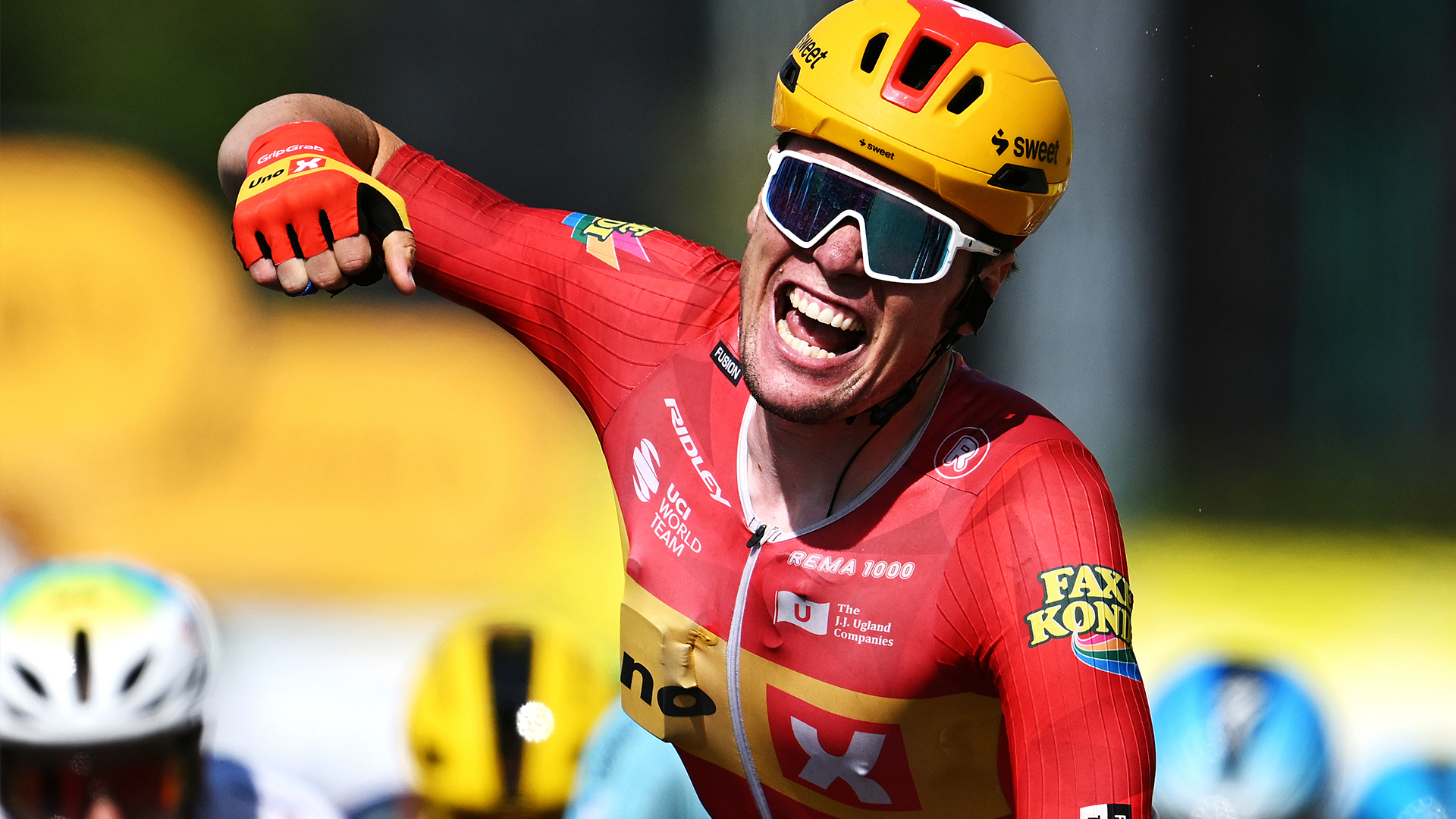
A look back at the historic days when Uno-X Mobility claimed a stage victory in all three Grand Tours

Frederik Muff
Wind Tunnel Operator
31. August 2026
The FUSION Magazine
Frederik Muff
Wind Tunnel Operator
Thanks for signing up to our newsletter!
Related articles
FUSION and Uno-X Mobility Cycling look back on two great years
Read article
Why we created MAS Tech
Read article
Five years in a row: Behind the fastest bike split at the IRONMAN World Championships
Read article
Preview: Ironman Hawaii 2026
Read article
The world champion in the wind tunnel: 2006 vs 2026
Read article
We love development
Read article
Only three teams managed to win a stage in all three Grand Tours in 2026: Visma–Lease a Bike, UAE Team Emirates-XRG and Uno-X Mobility.
It could hardly have been scripted any better.
On a day when Norway was shrouded in grief following the death of King Harald, Andreas Leknessund raced to victory at the Vuelta a España, finishing ahead of teammate Tobias Halland Johannessen.
The timing was worthy of a Hollywood film. Wearing black armbands, two Norwegian riders claimed the first two places on stage seven of the Vuelta a España. It was not only an emotional moment for Norwegian cycling fans, but also a monumental achievement for Uno-X Mobility. The team became just the third in 2026 to win a stage in all three Grand Tours.
The calibre of that company speaks for itself. The only other teams to achieve the feat were Visma–Lease a Bike and UAE Team Emirates-XRG - two of the biggest-budget teams in the sport and the two teams currently leading the world team rankings.
By comparison, Uno-X Mobility sits 13th. That is an impressive position in the team’s first WorldTour season, but hardly one from which it would be expected to achieve something as difficult as winning a stage in each of the three Grand Tours.
The first victory came courtesy of Fredrik Dversnes on stage 15 of the Giro d’Italia. In many ways, it was the most spectacular of the three.
That was largely because the flat stage profile and the composition of the breakaway, Dversnes and three other riders, had all the hallmarks of a classic TV breakaway: a move destined to be caught before the finish and replaced by a bunch sprint.
The riders refused to surrender their advantage, however, and Dversnes proved the fastest at the line. Wearing FUSION’s Breakaway Suit, designed specifically for conditions like these, the Norwegian had the decisive advantage that helped him secure victory on the fastest road stage in Giro d’Italia history. The riders averaged more than 51 km/h!
 Dversnes and his teammates celebrate on the team bus after the stage. Photo: Uno-X Mobility.
On stage 11 of the Tour de France, the tactical masterclass from the Giro d’Italia was replaced by raw power and impeccable timing.
Søren Wærenskjold had endured a disastrous stage the previous day. He crashed on the descent of the Puy Mary and crossed the finish line in last place. Expectations for the normally powerful Norwegian sprinter had therefore been reduced to a minimum.
Few expected to see Wærenskjold launch a ferocious sprint from 350 metres out and surge past major names such as Olav Kooij and Jasper Philipsen. But that is exactly what happened, securing the team’s second Grand Tour stage victory.
Once again, it came on a record-breaking day: the fastest road stage ever ridden in Tour de France history, at an average speed of 50.9 km/h - a pace at which aerodynamics and meticulous optimisation become hugely important.
 Wærenskjold celebrates at the Tour de France. Photo: Getty Images
Stage seven of the Vuelta a España began with anything but joy and celebration. The Uno-X Mobility riders gathered at the front of the peloton for a moment of remembrance following the death of Norway’s King Harald, wearing black armbands and sombre expressions.
It was therefore a victory of the most poignant kind when Andreas Leknessund attacked on the final climb to Valdelinares and rode solo across the finish line, with teammate Tobias Halland Johannessen taking second place.
The victory also offered Leknessund redemption after an impressive Giro d’Italia earlier in the year, where the Norwegian had been forced to settle for second place on three separate occasions.
 Leknessund on the podium following his Vuelta triumph. Photo: Uno-X Mobility.

Next article
Preview: Ironman 70.3 World Championship Nice
10. September 2026
The FUSION Magazine
4 min read