The world champion in the wind tunnel: 2006 vs 2026

Sebastian Ryttersgaard
Windtunnel Operator
06. October 2026
The FUSION Magazine
Sebastian Ryttersgaard
Windtunnel Operator
Thanks for signing up to our newsletter!
Normann Stadler won the iconic world championship in Kona in 2006. Now, 20 years later, he is returning as an age-group athlete. But what has changed in those two decades, and how far has the equipment come? We set out to find out, while also exploring what the achievements of the past might still teach us.
Normann Stadler’s second world title in long-distance triathlon, in October 2006, was built on an extraordinary bike split. The German not only set a new Kona course record of 4 hours, 18 minutes and 23 seconds, but also put more than 10 minutes (!) into his chasers. Despite Chris McCormack’s determined pursuit, Stadler held off the Australian and crossed the finish line celebrating his second world title.
Stadler’s life has changed dramatically since that victory. Serious heart problems led to extensive treatment and surgery, taking a lasting toll on his body. Yet his passion for an active life, his desire to challenge himself and his love of triathlon endured. To mark the 20th anniversary of his victory, he has decided to return to the Pacific island where his dream came true twice in the mid-2000s. Both his body and the world around him have changed since then. So we invited him on a trip down memory lane to bring the past back to life and find out just how much has changed.
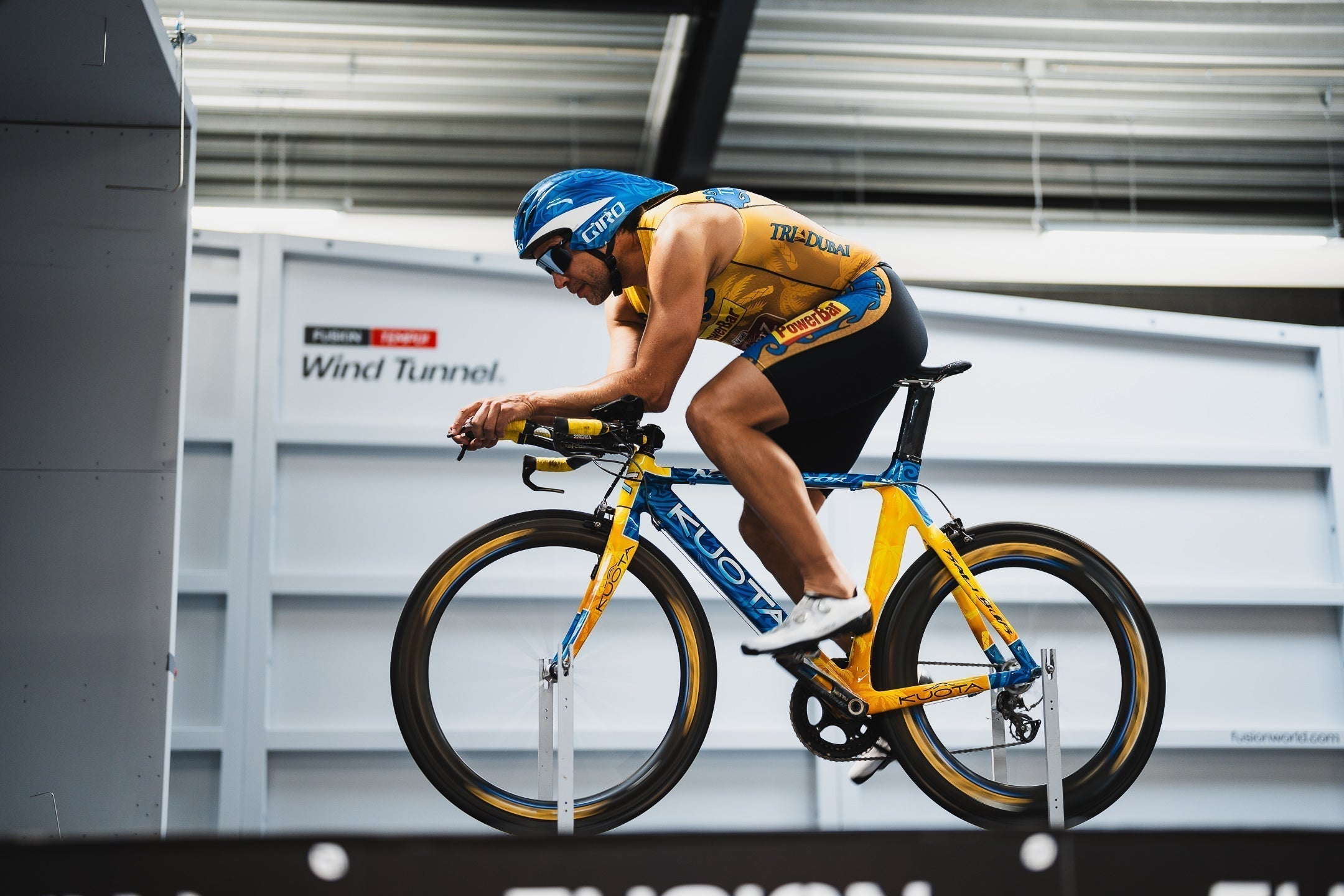
In our wind tunnel. With a direct comparison between then and now. Stadler had dug out the equipment he used on 21 October 2006: his old helmet, bike and clothing. Everything we needed to put 20 years of technological development to the test.

The first thing that stood out was his extremely aggressive position, with almost horizontal arms and a very low stack height. It was a classic old-school setup, built around the idea of getting as low as possible.

Stadler looked like his old self, but admitted that riding 180 kilometres in that position today seemed almost unthinkable. Yet that was exactly how he set the course record in Hawaii 20 years ago. Holding such an aggressive position for 180 kilometres, one that would be considered uncomfortable by today’s standards, was an impressive feat.

After the first wind tunnel tests, Stadler enjoyed a welcome break to stretch out while we swapped his winning bike from 2006 for his brand-new Ridley Triton Fast. The difference was obvious as soon as he settled onto the bike. With a much higher stack and his arms angled slightly upwards, he could hold the position far more comfortably.
Visually, the difference was enormous. Yet the aerodynamic gap between the 2006 bike in the old position and the modern setup was surprisingly small: less than three watts. And it was the 2006 setup that came out ahead.
That is a striking result. At first glance, it might suggest that bikes have barely progressed in 20 years. But the explanation is far more nuanced.
What makes the near-identical aerodynamic performance so interesting is how much more comfortably Stadler sat on the new bike. His hip angle was much more open, his torso was higher, and he was no longer folded into the compact, compressed position he used in 2006.
Riding position accounts for a large proportion of aerodynamic drag. So the more telling conclusion is how far technology has come: despite being 20 years older, with less mobility and a body changed by serious illness, Stadler could achieve almost the same aerodynamic performance.
With that comparison complete, we turned to clothing. We replaced his shorts and top from 2006 with our Tempo Pro Suit, initially keeping the old Giro helmet. The aim was to test each change in isolation and see exactly what 20 years of development had delivered. This was perhaps the biggest eye-opener of the day for Stadler.
The figures on screen showed a marked difference between the clothing he wore to win the world title 20 years ago and the suit he will race in this year. Across the tested speeds, we measured an average saving of 22 watts. At 46 km/h, the difference exceeded 30 watts.

Those figures make sense. Aerodynamic clothing has come a long way over the past two decades. It is no longer simply something you have to wear. Materials, textures and seams are carefully chosen and positioned to control airflow and minimise drag. The difference between Stadler’s sleeveless top from 2006 and his suit for 2026 is substantial: the textures of today’s fabrics are designed to reduce the aerodynamic wake behind the rider.
With the clothing sorted, we moved on to helmets. The old Giro helmet from 2006 was still impressively competitive in the initial position. We tested it against the Abus Timeshifter and Rudy Project and found surprisingly little between them aerodynamically. The newer helmets, however, offer much better comfort, ventilation and safety.
Next, we looked for further improvements. Stadler’s new position clearly still had plenty of untapped potential. With only a short time until the world championship, we focused on adjustments he could realistically use on race day.
Small adjustments to his position and the addition of calf sleeves delivered further aerodynamic gains. We also integrated the hydration systems he needed while adding as little drag as possible. The ability to carry enough fuel, and the performance benefits of doing so, is another area that has changed significantly since Normann last raced in Hawaii.

After five and a half hours in the wind tunnel, we could answer the question we had set out to explore: how much faster might the 2006 world champion have been if he could have taken today’s setup back in time with him?
The average saving across the tested speeds was 33 watts, rising to an impressive 47 watts at 47 km/h.
Assuming the same fitness and race conditions, modern equipment would have cut just over 11 minutes from Stadler’s Kona bike split. That calculation does not include the improvements in rolling resistance and chainline efficiency since 2006. Nor does it account for the huge advances in sports nutrition and training methods.
Add a more comfortable position, more capacity for hydration and nutrition, and all the other improvements outside these calculations, and today’s racing speeds start to make sense. The test also leaves us with another thought: with the physical ability he had in 2006, it would be fascinating to see Stadler take on today’s stars.
Exactly how much faster he would have been in 2006 is difficult to say. The progress in technology, however, is beyond doubt.
