When the Entire Team Went on the Attack

Sebastian Ryttersgaard
Windtunnel Operator
17. September 2026
The FUSION Magazine
Sebastian Ryttersgaard
Windtunnel Operator
Thanks for signing up to our newsletter!
Related articles
FUSION and Uno-X Mobility Cycling look back on two great years
Read article
Why we created MAS Tech
Read article
Five years in a row: Behind the fastest bike split at the IRONMAN World Championships
Read article
Preview: Ironman Hawaii 2026
Read article
The world champion in the wind tunnel: 2006 vs 2026
Read article
We love development
Read article
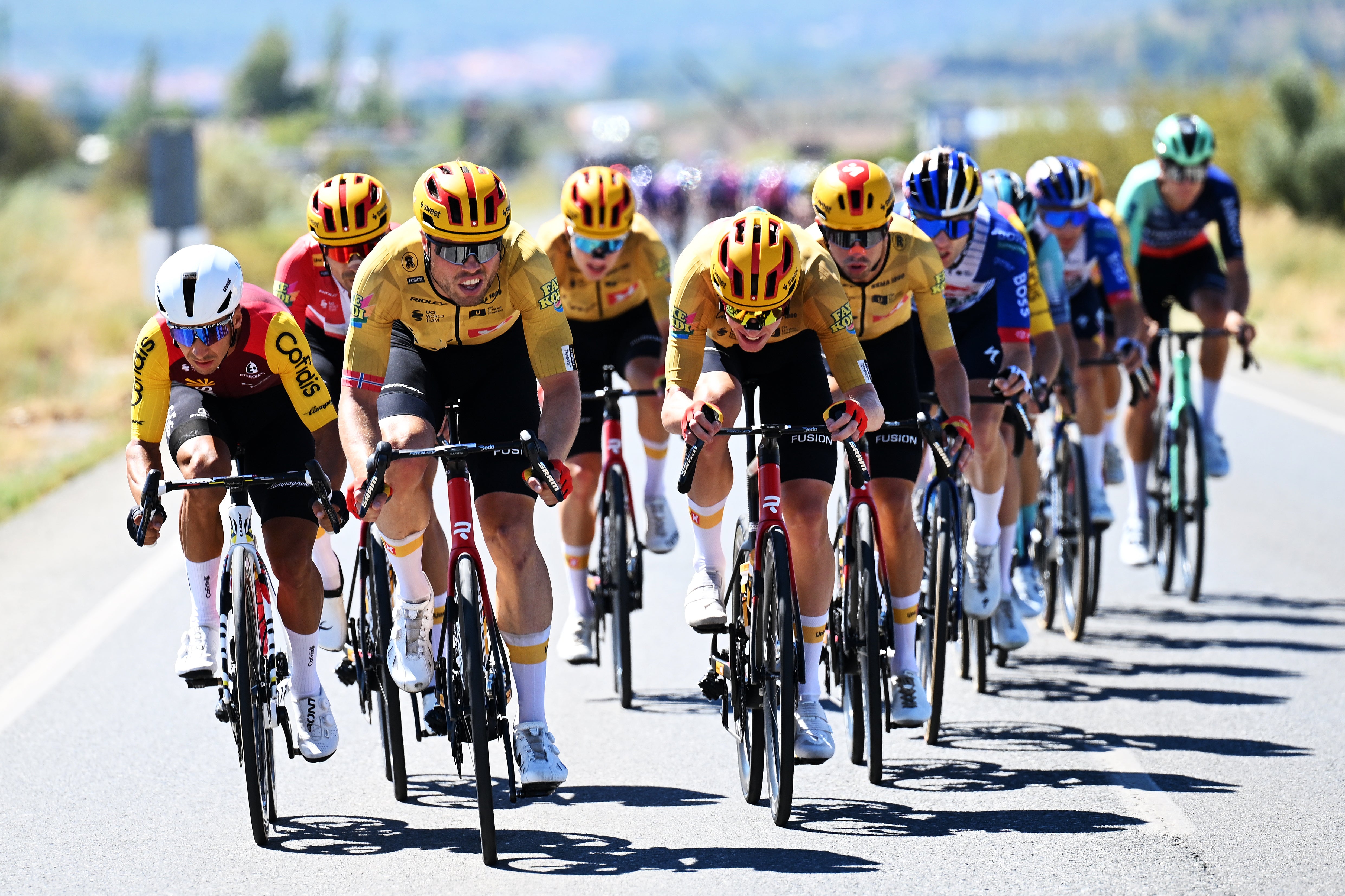
Photo: Getty Images
One of our absolute highlights from this year’s Vuelta a España unfolded on stage 20 - a day when Uno-X Mobility demonstrated what can happen when no rider puts himself above the team.
As an increasingly fatigued peloton rolled out for the penultimate stage of the race, Uno-X Mobility decided to seize the initiative. Not with a single rider, but with virtually the entire team.
The attack looked meticulously planned and perfectly timed. In reality, it was far more spontaneous. When captain-du-route Magnus Cort moved to the front and opened up the race in the crosswinds, his teammates responded immediately. With around 170 kilometres remaining, six of the team’s eight riders were among the driving forces behind splitting the peloton and establishing a strong breakaway.
 Magnus Cort initiating the attack. Photo: Getty Images
From that moment on, there was nowhere to hide.
Together with the other riders in the breakaway, Uno-X Mobility had to overcome the wind, the heat and the rolling terrain before the stage reached the major climbs. The objective was clear: the gap needed to be as large as possible by the foot of the mountains. Only then would the team’s climber, Tobias Halland Johannessen, have the opportunity to fight for the stage victory without the general classification favourites coming back into contention.
Establishing the decisive breakaway in a Grand Tour is a demanding task in itself. On stage 20, after almost three weeks of racing and against some of the strongest riders in the world, it becomes even more difficult. From the moment the attack was launched, the Uno-X riders and their breakaway companions had just under 70 kilometres before the first decisive climbs began. This was the section of the route where the foundation for the result had to be laid.
Here, the riders demonstrated how much of a difference strong teamwork can make when every detail is also in place.
Every turn on the front had to be measured correctly. The riders needed to maintain the most efficient possible position on the bike whenever they moved into the wind at the head of the group. Their energy had to be used on the sections of the route where it could make the greatest difference. At the same time, the pace had to remain high enough to prevent the peloton behind from re-establishing contact.
The numbers clearly illustrate the intensity of the effort.
When Uno-X Mobility moved to the front to exploit the crosswinds, the speed increased dramatically. The riders’ official Strava files show that the first 15 kilometres after the attack were covered at more than 60 km/h. By the time the breakaway reached the foot of the first climb, the riders had completed almost 70 kilometres at an average speed of 49.3 km/h.
 Photo: Getty Images
At speeds like these, aerodynamics is not a marginal detail. It is a decisive part of performance. For the rider at the front of the breakaway, as much as 80–90 per cent of the power produced is used to overcome aerodynamic drag. This means that riding position, clothing and equipment all play a significant role – particularly when the riders must repeatedly take hard turns at the front while preserving enough energy for the decisive finale.
It also underlines the shared responsibility involved in developing the riders’ equipment. When the race explodes and speeds rise above 60 km/h, the equipment must provide the riders with the support they need. Not only during controlled testing, but in real racing conditions – in heat and wind, under maximum physical strain, and after almost three weeks of Grand Tour racing.
That is precisely why stage 20 stands out as one of our greatest highlights from this year’s Vuelta a España. The courage, determination and teamwork of the Uno-X riders put both the athletes and their equipment to the ultimate test. Both delivered.
 Photo: Getty Images
At the foot of the mountains, the gap had grown to more than ten minutes. The team’s collective effort had created the best possible starting point, and from there, a new race began. A race in which Tobias Halland Johannessen was able to build on the enormous work of his teammates and ultimately cross the finish line in an impressive second place.
The result belonged to Tobias. But the performance belonged to the entire team.
Next article
We love development
Three of Uno-X Mobility’s young Danish talents, Henrik Breiner Pedersen, Carl-Frederik Bevort and Tobias Svarre, have all claimed their first professional victories within just a few days. The story follows their development from young talents to professional riders, and how FUSION, through its partnerships with Team ColoQuick and Uno-X Mobility, has been part of the journey.
25. September 2026
The FUSION Magazine
5 min read